
Recently, Prof. WANG Wei’s research group has published a research work on the journal “Advanced Science” titled with “Magnetic-Field-Tuned Spin-Dependent D-Band and Bifunctionality in L10-FeCoPt for Enhanced Methanol Oxidation”.The corresponding institution is the School of Mathematics and Physics of Beijing University of Chemical Technology. The first author is MO Qiqi. Prof. WANG Wei and LIU Jialong are the corresponding authors of this paper. This research work was funded by the National Natural Science Foundation of China.
As the core of direct methanol fuel cells, the methanol oxidation reaction (MOR) involves the transfer of six electrons from CH₃OH to the final product CO₂, in which the reaction between CO* and OH* is generally the rate determining step. The synergistic effect of noble metal alloy catalysts can optimize MOR kinetics and achieve excellent performance; this effect generally involves two reaction mechanisms, namely the d band center mechanism and the bifunctional mechanism. Although it has been reported that both mechanisms coexist in PtIr alloys and enhance both activity and stability, it is not easy to distinguish how alloying simultaneously modulates the electronic band structure and the surface active sites. This is because adding a new element to the surface not only provides new active sites for the reaction but also alters the electronic structure of the surrounding coordinating atoms and thus affects adsorption properties. Such ambiguous understanding is unfavorable for catalyst configuration design. On the other hand, the role of spin in electrochemical reactions is receiving increasing attention. Spin polarization induced by an external magnetic field can optimize the spin state of intermediate species and improve reaction performance, which is closely related to the spin–electronic structure of spin catalysts and their magnetic field response. In our previous work, we reported that a small amount of Cr forms a ternary alloy with FePt to enhance electrocatalytic methanol oxidation performance. However, Cr and other related elements (Mn, Bi, etc.) differ greatly in electronegativity from Pt, resulting in a low degree of alloying and incomplete mutual solubility. Therefore, in this work, taking advantage of the mutual solubility of Co with both Fe and Pt, we achieve large range regulation of the spin–electronic structure of L1₀ FeCoPt through continuous variation of the Co content, and use a magnetic field to regulate the polarization state. We confirm the simultaneous existence of the d band center mechanism and the bifunctional mechanism, providing a new approach for the design of novel spin catalysts.
In this study, a series of L10-phase FeCoPt nanoparticles were prepared via a hydrothermal/annealing method, which not only enables continuous adjustment of the Co proportion over a wide range but also allows control of the d-band center shifts of the three elements. Experiments and first-principles calculations show that the kinetics of the methanol oxidation reaction (MOR) is governed by the reaction between CO* and OH*, and that these two adsorbed intermediates are regulated not only by the Co content, methanol concentration, and solution pH but also by the net spin and the d-band center. This work demonstrates the simultaneous modulation of the spin–electronic structure and the bifunctional effect by a magnetic field, elucidates the multi-factor enhancement mechanism, and provides a new route for designing high-performance spin catalysts for direct methanol fuel cells.
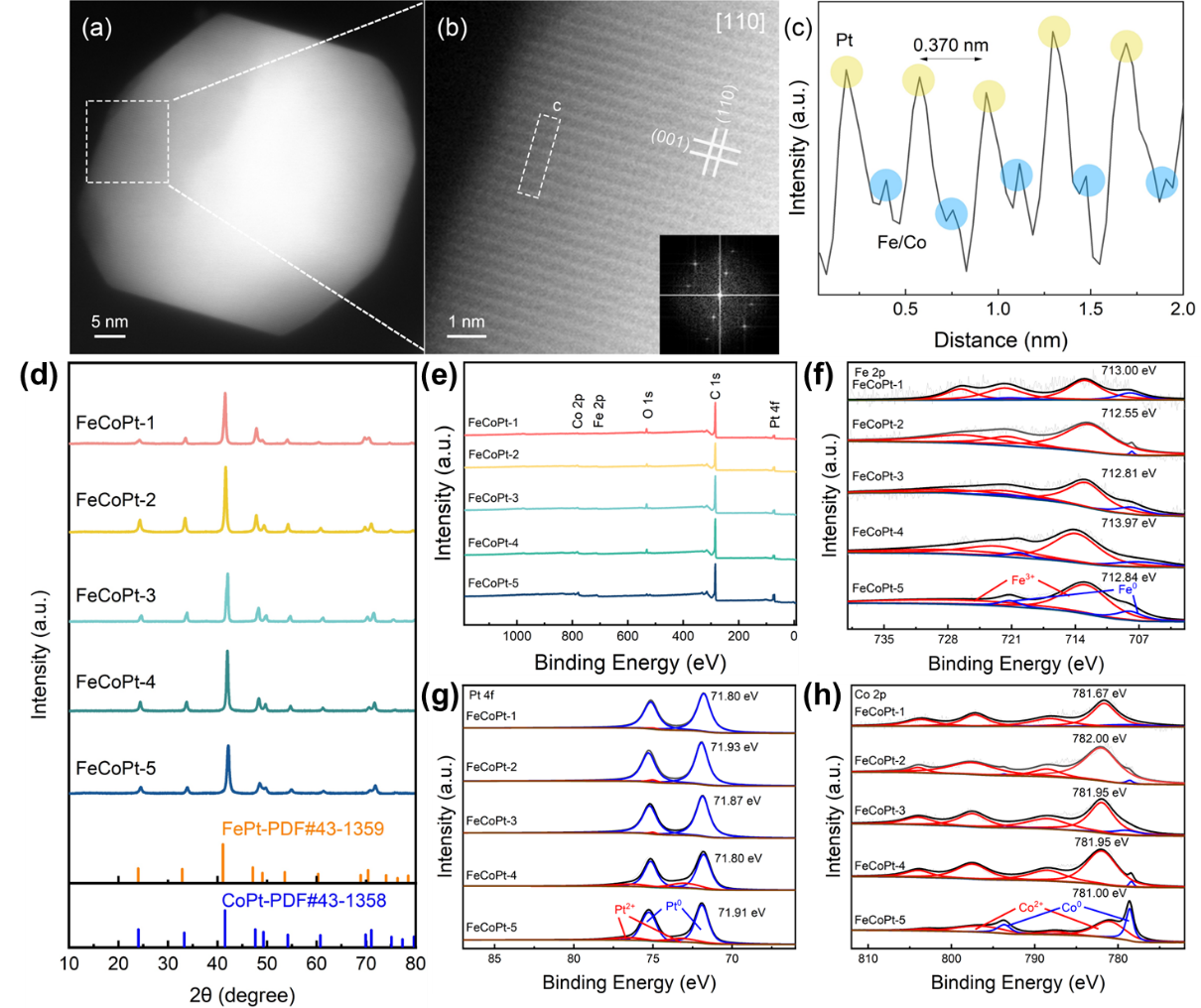
Figure 1 (a–b) HAADF-STEM images of L10-FeCoPt along the [110] zone axis. (c) Z-contrast intensity line-scan profile taken from the white box in (b). Crystal structure and electronic structure of the five FeCoPt samples: (d) XRD patterns. (e) XPS survey spectra and high-resolution XPS spectra of (f) Fe 2p, (g) Pt 4f, and (h) Co 2p.
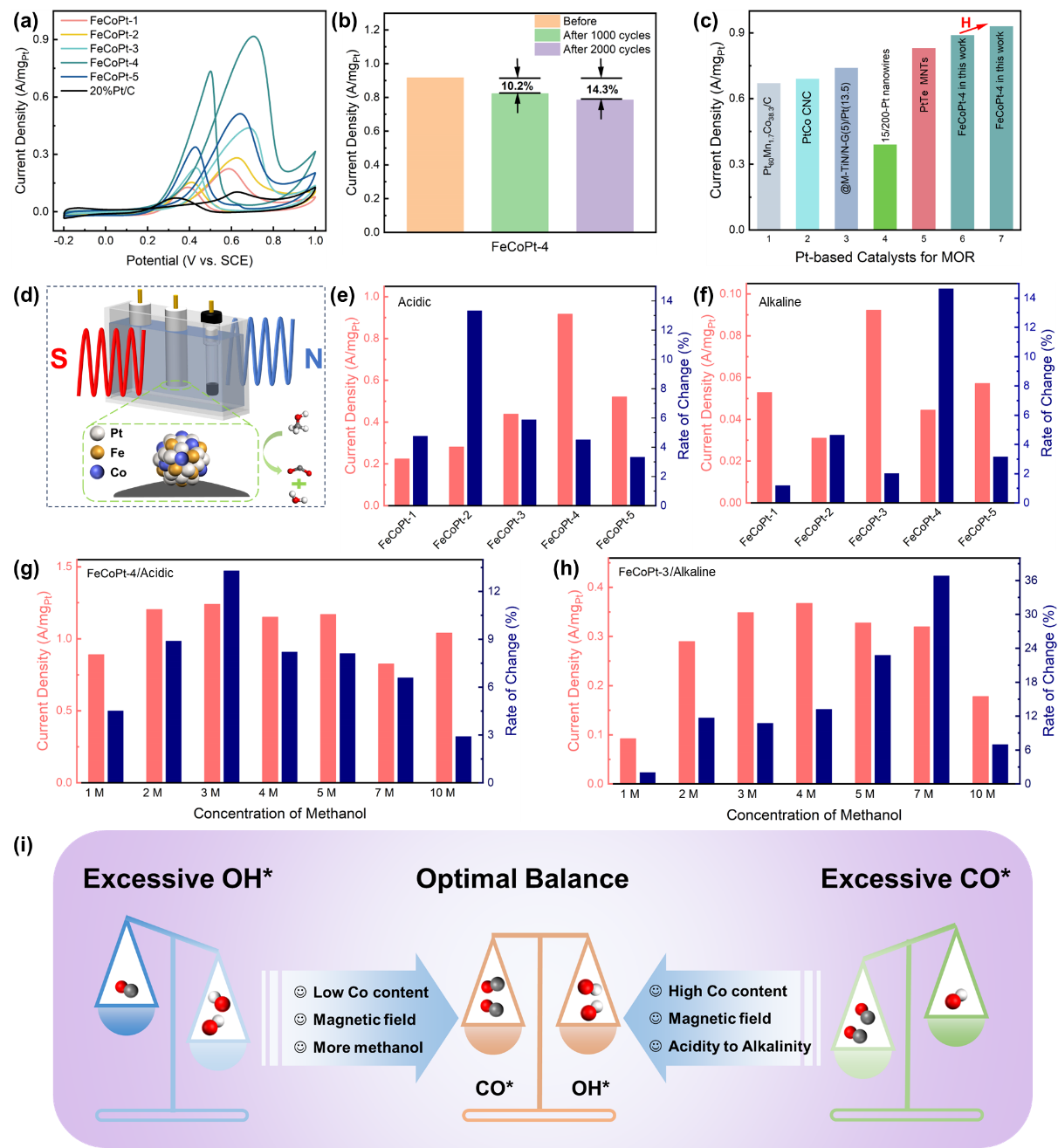
Figure 2 (a) CV curves in acidic methanol solution. (b) ADT tests of FeCoPt 4 for 1000 and 2000 cycles under magnetic field free conditions. (c) Comparison of MOR performance. (d) Schematic of the magnetic field assisted electrochemical testing system. (e) Variation of the If peak current and R(H) under an 8000 Oe magnetic field in acidic and (f) alkaline methanol solutions. (g) Relationship between methanol concentration and the If peak current as well as R(H) under an 8000 Oe magnetic field for FeCoPt 4 in 0.5 M H₂SO₄ and (h) for FeCoPt 3 in 1.0 M KOH. (i) Equilibrium model of MOR with respect to methanol concentration, Co content, and acid/base conditions.
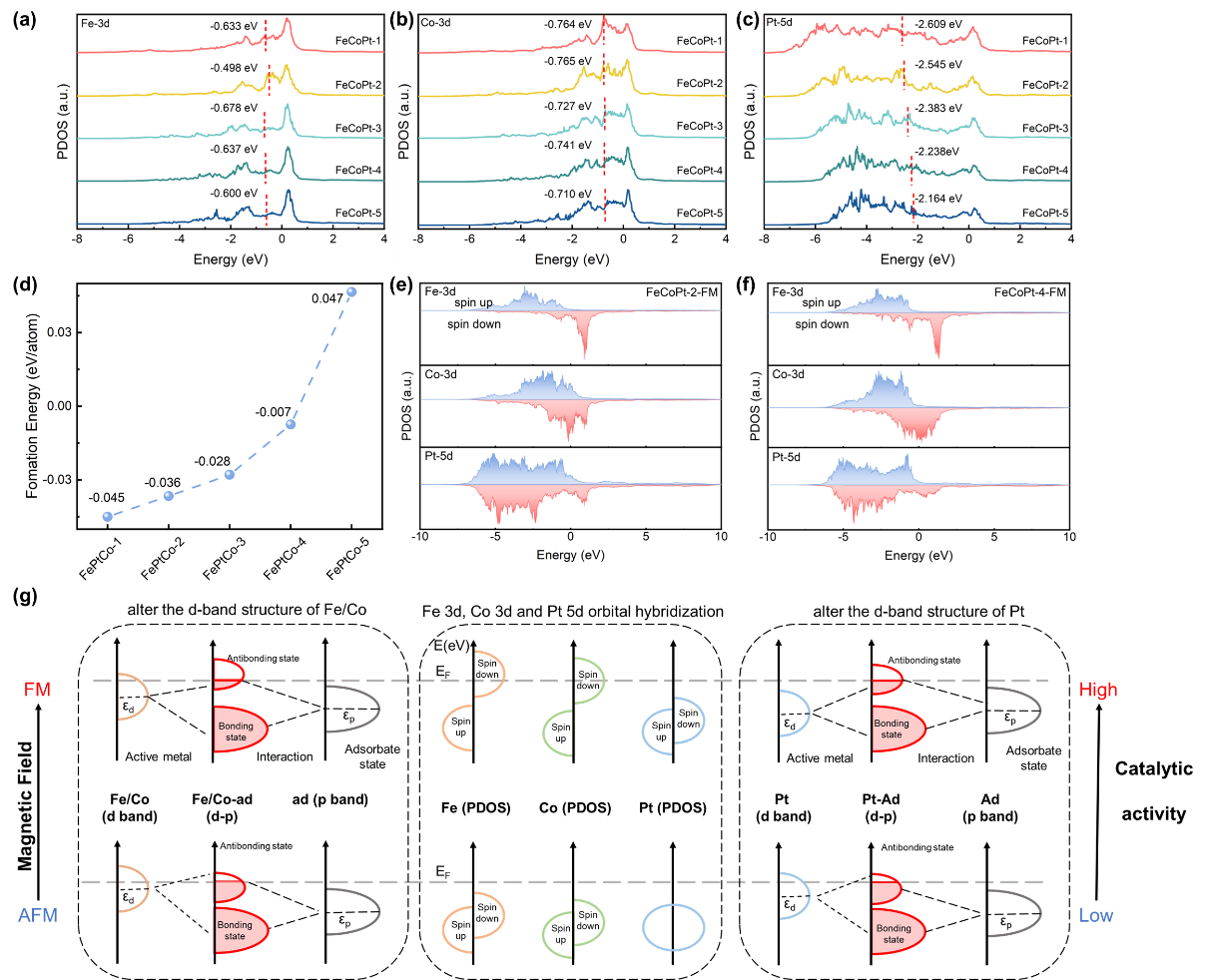
Figure 3 (a) PDOS of Fe 3d, (b) Co 3d, and (c) Pt 5d in L10-FeCoPt. (d) Formation energy of L10-FeCoPt. Spin-polarized PDOS of Fe 3d, Co 3d, and Pt 5d in (e) FeCoPt-2 and (f) FeCoPt-4. (g) Mechanism of d-band center shifts of Fe, Co, and Pt under a magnetic field.
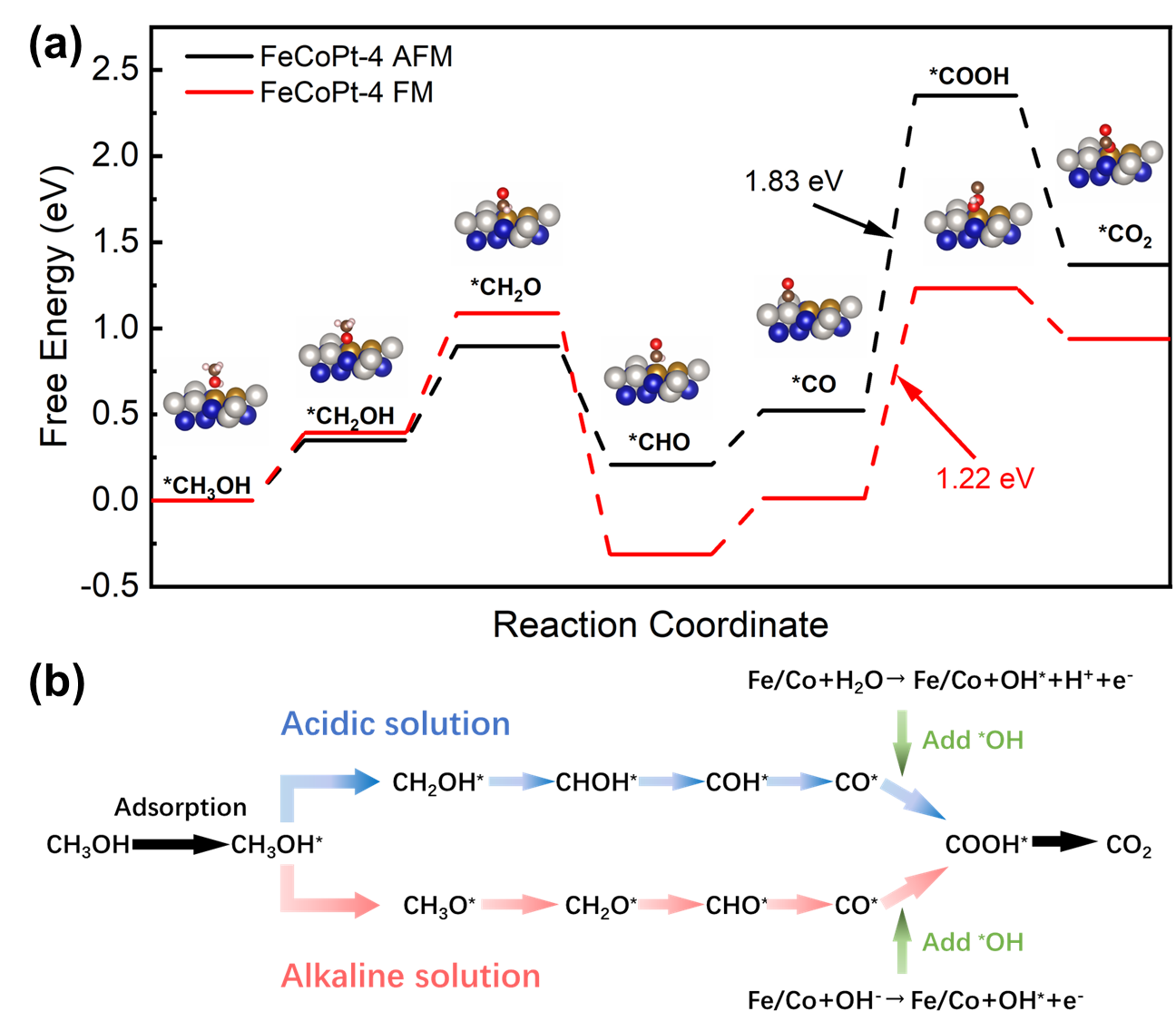
Figure 4 (a) Gibbs free energy of the multi-step MOR for FeCoPt 4 in the antiferromagnetic (AFM) and ferromagnetic (FM) states at zero potential. (b) Reaction mechanism diagram of the entire MOR process.
Website:https://advanced.onlinelibrary.wiley.com/doi/10.1002/advs.78112
Contributed by: Fu Jingquan
Reviewed by: Wang Lijun、Lin Chengyou and Fu Jingquan