
Recently, Dr. Yating Yang, a young faculty member of our institute, collaborated with research teams from Sun Yat-sen University, Changsha University of Science and Technology, the Institute of Acoustics of the Chinese Academy of Sciences, and Wuhan University to publish a research paper entitled “Manipulating Topological Boundary States: From Corner-Bound to Arbitrarily Positioned Extended States” in Physical Review Letters.
Relying on the bulk boundary correspondence, topological insulators host symmetry-protected topological boundary states. Second-order topological insulators are most notably characterized by zero-dimensional topological corner states. Owing to their topological robustness, such corner states have been extensively investigated in artificial metamaterial platforms including acoustics, photonics, and electrical circuits. Nevertheless, topological corner states have long been tightly confined to the geometric corners of structures. Modifying their spatial position usually demands large-scale reconstruction of the bulk material architecture, which severely restricts practical device design and applications. Freely tuning the position and wave-function profiles of topological boundary states without altering the bulk material remains a key challenge to be addressed.
In this work, we address this fundamental challenge in experiments and demonstrate two key advances, establishing a new paradigm for the unique manipulation of topological boundary states. By leveraging boundary sublattice degree of freedom without extensive bulk modifications: (1) we move the corner state [Fig. 1(a)] along the edge as a topological bound state (TBS) [Fig. 1(b)], with its position tunable precisely from site to site; and (2) we further continuously transform it into an extended TBS, which we term a topological extended state (TES), capable of accommodating an arbitrary width [Fig. 1(c)].
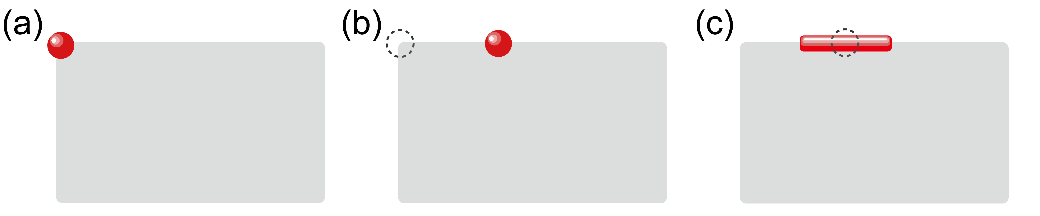
Figure 1 Illustration of topological corner states drifting. (a) Corner state initially localized at the corner in a SOTI. (b) Corner state drifting away from corner and forming a TBS localized at edge. (c) ‘Corner state’ delocalized to accommodate a width as a TES.
A tight-binding model for a bilayer honeycomb lattice is constructed, and the results reveal that different types of edges (twig-A, twig-B, and armchair edges) produce boundary Dirac masses with distinct magnitudes and signs. Specifically, twig-A and twig-B edges possess boundary Dirac masses of equal magnitude but opposite sign, whereas the Dirac mass of the armchair edge equals zero. When a twig-B/twig-A sublattice heterostructure is constructed, the sign reversal of Dirac mass will lead to a TBS emerge at the sublattice domain wall on the boundary rather than at geometric corner. By inserting the armchair edge with zero Dirac mass between twig-B and twig-B edges, a sandwich-type “twig-B-armchair-twig-A” sublattice domain wall is formed. Localized TBS spreads uniformly along the armchair edge and evolves into a TES, whose spatial width is fully determined by the number of inserted armchair edges. Protected by particle-hole symmetry and chiral symmetry, both TBS and TES are pinned at zero energy and exhibit robustness.
To validate the theoretical predictions, we design and fabricate phononic crystal. Experiments clearly demonstrate that acoustic TBS is sharply localized at sublattice heterostructures on edges. TBS can be placed at arbitrary edge positions by repositioning the domain wall. For samples with the sandwich-type boundary, TBS spreads evenly across the armchair edge to form acoustic TES. Numerical simulations show good agreement with experimentally measured acoustic-pressure distributions, verifying the feasibility of this boundary-engineering strategy for acoustic systems.
Dr. Yating Yang, Associate Professor from the College of Mathematics and Physics at Beijing University of Chemical Technology, and Dr. Di Zhu from Sun Yat-sen University are co-first authors of this paper. Prof. Zhongbo Yan (Sun Yat-sen University), Prof. Weiyin Deng (Wuhan University), and Academician Zhengyou Liu are co-corresponding authors. Beijing University of Chemical Technology is the first-affiliation institution. This work is supported bythe National Key R&D Program of China, the National Natural Science Foundation of China, and the Fundamental Research Funds for the Central Universities.
Article link:https://doi.org/10.1103/cpzv-qc5v
About the author: Yating Yang, Ph.D., is an Associate Professor at the College of Mathematics and Physics, Beijing University of Chemical Technology. Her research interests cover acoustic metamaterials, topological phononic crystals, and active acoustic metamaterials. She has published more than ten relevant research papers in prestigious journals includingPhysical Review Letters,Communications Physics,Physical Review B,Physical Review Applied and so on. She hosts theNational Natural Science Foundation of China, the China Postdoctoral Science Foundation and the Fundamental Research Funds for the Central Universities.