
Recently, Prof. WANG Wei’s research group has published a research work on the journal “Applied Catalysis B-Environment and Energy” titled with “Phase transition and ternary alloying synergistically boosting magnetic field response for methanol oxidation reaction on L10-FeCrPt nanochains”.
Building a carbon-neutral green energy system is an important goal for achieving the transition to clean energy, and it has received extensive attention in recent years. Direct methanol fuel cells (DMFCs) are regarded as a potential ideal power source for portable electronic devices due to their high energy density, low cost, and good safety. The core reaction of DMFC is methanol oxidation reaction (MOR), and using methanol instead of traditional fossil fuels can help reduce carbon dioxide emissions. Through photocatalysis or electrocatalysis technologies, the generated carbon dioxide can be reconverted into small molecule C1 compounds such as methanol, thereby achieving a closed carbon cycle and promoting carbon neutrality. Therefore, developing efficient strategies to accelerate the kinetics of the MOR reaction is of great significance for promoting the development of DMFC technology. In recent years, one of the research focuses has been to explore the influence of magnetic fields on the electrocatalytic reactions of inorganic small molecules (such as H2, O2, CO2, NOx), and thereby developing spin catalysts with significant magnetic field response capabilities, including nanoparticles, metal monomer catalysts, two-dimensional materials, and heterostructures. The external magnetic field can not only enhance catalytic activity but also improve the overall performance of the battery. However, there are still several challenges in strengthening the magnetic field effect in the MOR process: (1) Lack of a synthesis strategy for spin catalysts with strong magnetic field response and high catalytic activity; (2) No universal parameters have been established to describe the response characteristics of materials to magnetic fields; (3) The understanding of the structural evolution process of catalysts under the influence of magnetic fields is still not deep; (4) The cognition of magnetic-sensitive reaction intermediates is relatively limited. Solving these problems will lay a theoretical foundation for the precise design and construction of spin catalysts. Designing magnetic materials with strong external magnetic field response capabilities is crucial for improving the efficiency of electrocatalytic and thermal catalytic reactions in energy conversion and storage systems. Although significant progress has been made in the research of spin catalysts for hydrogen and oxygen-related electrocatalytic reactions, the spin catalyst system for organic small molecule reactions is still insufficient, which largely limits the in-depth exploration of the mechanism of the magnetic influence on electrochemical reactions.
This study utilizes L10-FeCrPt nanochains prepared by coating and annealing as the model system. Through the synergistic effect of ternary metal alloying and phase transformation, the spin-electron structure can be regulated, thereby enhancing the magnetic response characteristics and achieving the promotion effect of the magnetic field on the methanol oxidation reaction. The magnetic moment parameters obtained through activation energy calculation are used as descriptors to estimate the reduction effect of the magnetic field on the activation energy, and further demonstrated the reaction mechanism of CO* and OH* adsorption and O-H bond breakage steps under the influence of the magnetic field. The L10-FeCrPt nanochains constructed in this study exhibit excellent structural stability and significantly enhanced magnetic response characteristics. After alloying Cr with FePt and completing the transformation from the FCC phase to the L10 phase through coating and annealing, an 8000 Oe magnetic field could increase the MOR activity of L10-FeCrPt by 41%, exceeding 13% of FCC FeCrPt and 30% of L10-FePt. Based on the linear relationship between activation energy and magnetic field, the magnetic moment parameter (M) is proposed to evaluate the magnetic response characteristics. The M value of L10-FeCrPt reaches 46839 emu/g, which is 2.7 times that of L10-FePt. DFT calculations indicates that the external magnetic field helps to optimize CO* adsorption, O-H bond breakage, and the participation of OH* active groups in the reaction, resulting in a significant reduction in the reaction barrier of L10-FeCrPt. This study provides a method for designing spin catalysts with high magnetic response characteristics through ternary alloying and phase engineering.
The corresponding author of this paper is from the College of Mathematics and Physics of Beijing University of Chemical Technology. Mo Qiqi, a 2023-level master's student of the school, is the first author of this paper. Professor Wang Wei and Associate Professor Liu Jialong are the corresponding authors of this paper. This research work is funded by the National Natural Science Foundation of China.
Website:https://doi.org/10.1016/j.apcatb.2026.126475
Picture and Text Description:
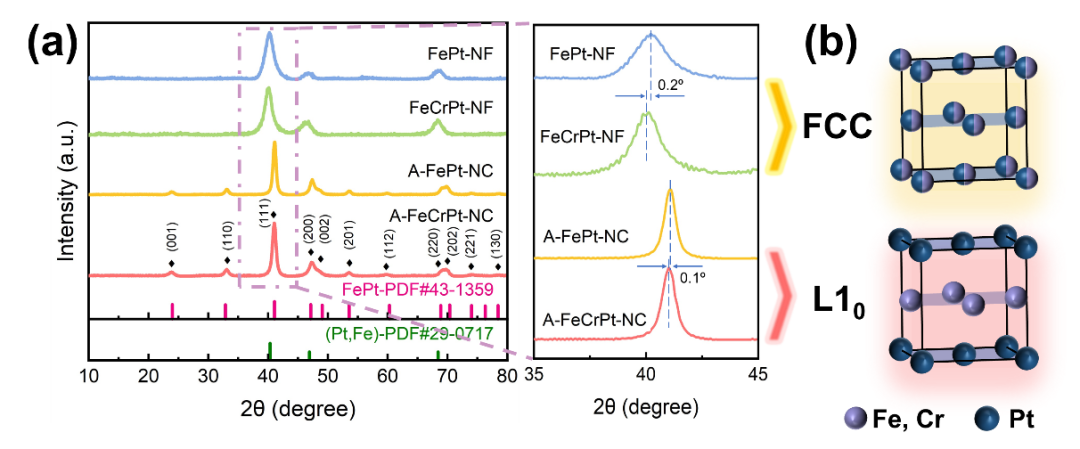
Figure 1 (a) XRD for FePt-NF、FeCrPt-NF、A-FePt-NC and A-FeCrPt-NC. (b) Structure models for FCC-FeCrPt, L10 A-FePt-NC and A-FeCrPt-NC.
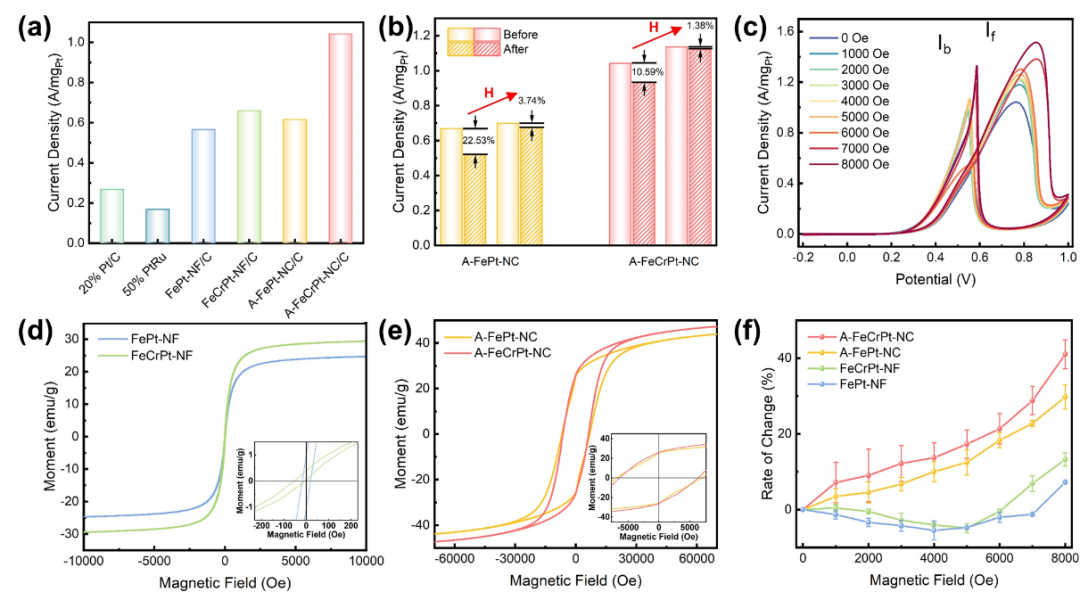
Figure 2 (a) The If peak current of the sample in a room-temperature methanol solution without magnetic field. (b) The change If peak current before and after 1000 cycles of the ADT experiment. (c) CV curves under different magnetic fields for A-FeCrPt-NC. (d) M-H loops for FePt-NF and FeCrPt-NF at 300 K. (e) M-H loops for A-FePt-NC and A-FeCrPt-NC at 300 K. (f) The change of If peak current under different magnetic fields.
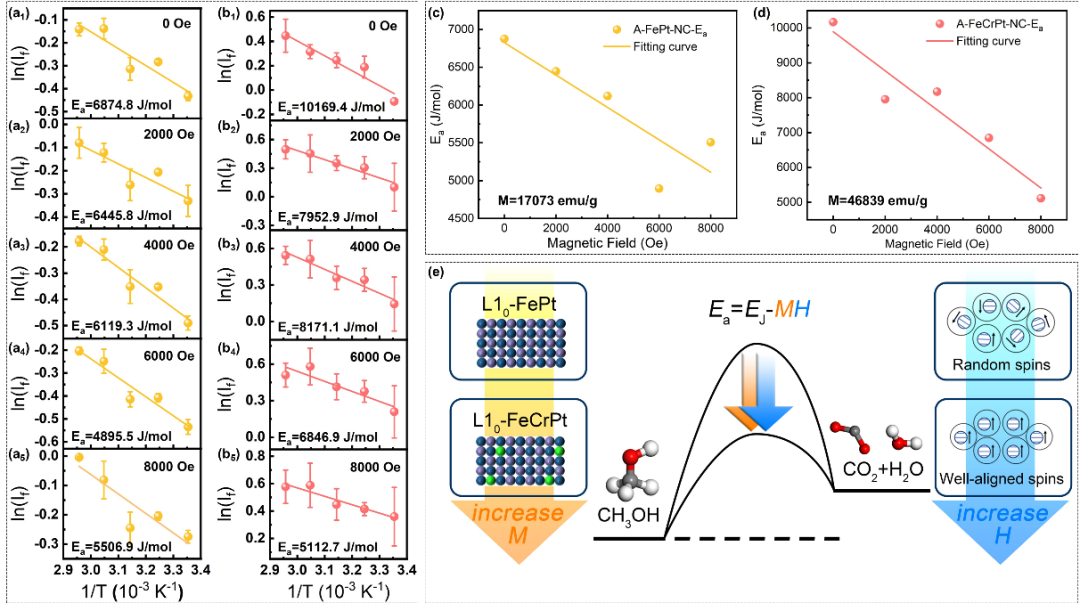
Figure 3 Arrhenius plots for (a1)-(a5) A-FePt-NC and (b1)-(b5) A-FeCrPt-NC under magnetic fields from 0 to 8000 Oe.(c-d)The fitting for activation energy with magnetic fields.(f)Mechanism for the decrease of activation energy.
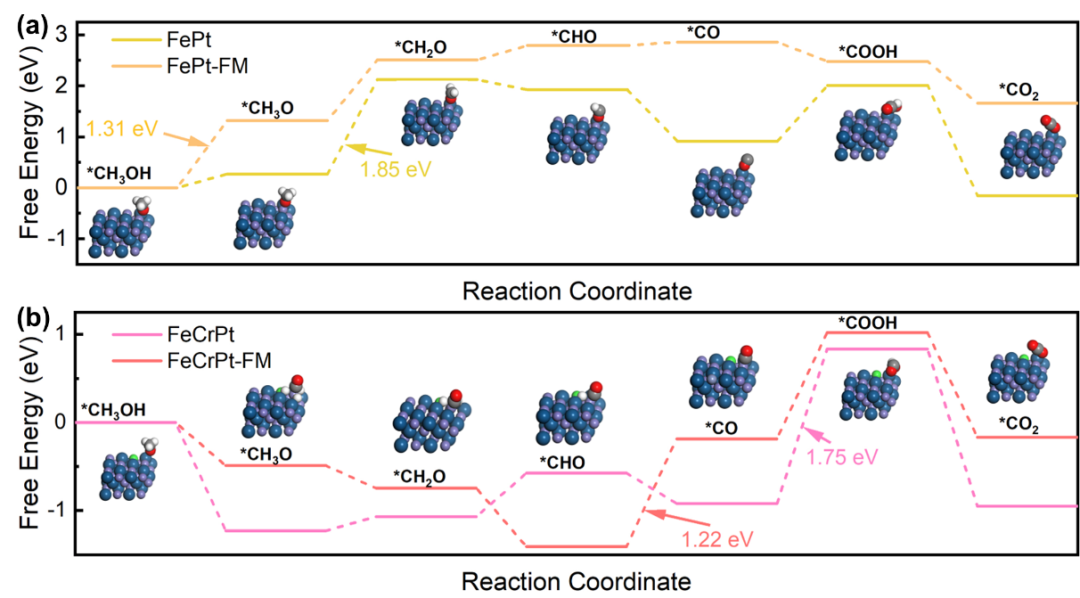
Figure 4 The reaction coordinates of the Gibbs free energy in the normal state and ferromagnetic state for (a) L10-FePt and (b) L10-FeCrPt.
Author Introduction:

Dr. LIU Jialong graduates from Beihang University and now is an associate professor at the College of Mathematics and Physics of Beijing University of Chemical Technology, a master's supervisor. He serves as a young editor for the journals "Rare Metals" and "SmartSys", and as a section editor for journal "Advanced Functional Materials". His research focuses on the preparation of magnetic nanomaterials, microstructure characterization and processing, and their applications in photocatalysis. Currently, he has published over 30 SCI papers as the first or corresponding author in international journals such as "Appl. Catal. B", "Energy Environ. Mater.", "Nano Res.", "Chem. Eng. J.", "Nanoscale", "Chem. Commun.", and "Sep. Purif. Tech.". He has also been responsible for several national and provincial-level scientific research projects, including the National Natural Science Foundation of China, as well as several other national and provincial-level projects, such as the CAS Priority Program, the Ministry of Science and Technology Major Project.

Prof. Dr. WANG Wei graduates from Shanghai Jiao Tong University and now is a professor at Beijing University of Chemical Technology, a doctoral supervisor. In 2012, he visited the Theoretical Physics Center in Italy. From 2014 to 2015, he conducted a visiting study at the University of Texas at Arlington in the United States. Currently, he serves as the dean of the College of Mathematics and Physics at Beijing University of Chemical Technology and is the section editors for several journals, including "Advanced Functional Materials", "Annalen der Physik", and "Advanced Magnetic and Quantum Materials". He is also a young editorial board member of "Materials Engineering" and "Aerospace Materials Journal". His research focuses on the structural regulation of magnetic nanomaterials, the mechanism of their properties, and related device research. He has long-term work experience in theoretical and experimental research on magnetic materials, with particular emphasis on the controlled preparation of ferrite magnetic nanomaterials, the structural construction and performance regulation of material systems such as two-dimensional graphene/transition metal sulfides, and the application of low-dimensional magnetic composite nanomaterials in electromagnetic shielding and photocatalysis fields. He has developed a series of experimental techniques and methods for the controlled preparation of low-dimensional nanomaterials. He has published over 100 research papers in academic journals such as JACS, Adv. Funct. Mater., Phys. Rev. B, Adv. Sci., etc. He has also been responsible for national natural science foundation projects for young researchers, general projects, international cooperation and exchange projects, and Beijing natural science foundation general projects.